

To examine the physical reason of the variability of M 2-54 (following the discussion in Paper I), we first need to estimate the star's position in the HR Diagram. We start with its effective temperature.
Two indirect determinations are available: using a modified Stoy method,
Kaler (1983) suggested that the effective temperature of M 2-54 is around
30000 K. Stasinska et al. (1997) derived a Zanstra temperature of
20000 K. Consequently, we adopt  K.
K.
Turning to mass and luminosity, we make use of the results of Stasinska
et al. (1997), who list  for M 2-54. Inserting
this and the effective temperature above into the evolutionary tracks of
Schönberner (1983), one obtains
for M 2-54. Inserting
this and the effective temperature above into the evolutionary tracks of
Schönberner (1983), one obtains  . Since
Stasinska
et al. (1997) did not give any error estimates for their derived
parameters, we assume an error size of
. Since
Stasinska
et al. (1997) did not give any error estimates for their derived
parameters, we assume an error size of  in log L. Combining all the
estimates, one obtains
in log L. Combining all the
estimates, one obtains  .
.
Since we do not have time-series spectroscopic data of M 2-54 available, we
cannot examine a binary hypothesis here. However, it is possible to say
something about a spot hypothesis. With the parameters inferred above, the
critical rotation period, which can be calculated as
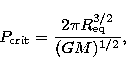 |
(1) |
 is the equatorial radius of the star
(
is the equatorial radius of the star
( ), becomes 39+30-24 hours for M 2-54. Only
by assuming an 14.3 hour modulation to be correct and only by adopting the lower
limit of the critical rotation period a spot hypothesis becomes feasible; it
is therefore unlikely. Still, we cannot rule it out, as we did for HD 35914.
), becomes 39+30-24 hours for M 2-54. Only
by assuming an 14.3 hour modulation to be correct and only by adopting the lower
limit of the critical rotation period a spot hypothesis becomes feasible; it
is therefore unlikely. Still, we cannot rule it out, as we did for HD 35914.
If we assume wind variability to be the cause for the short-term light variations and if we assume that the mechanism causing it is the same than for hot massive stars, we would expect the time scale to be correlated with the stellar rotation period as well (e.g. see Kaper et al. 1996). Consequently, this hypothesis is also only possible with improbable assumptions, just as the spot hypothesis. On the other hand, both ideas may explain the long-term variations in M 2-54 (and HD 35914).
The only remaining possibility for the short-term light variations is that they originate from stellar pulsations. We again follow the methods applied in Paper I to examine its feasibility. First, we calculate the pulsation "constant'' Q for the two possible periods recovered in the frequency analysis. If the 14.3 hour period is correct, one obtains Q=0.078+0.124-0.034 while for the 8.9 hour period Q=0.049+0.076-0.022 is found. We note that the large upper limits originate from error propagation of our inferred stellar parameters - which we consider to be very conservative.
Now we make use of Gautschy's (1993) pulsational model calculations for
post-AGB objects. In his models the
radial fundamental mode as well as the first overtone are pulsationally
unstable at  around 25000 K. Since his models are for
 , we cannot directly take the periods, but we can compare
the pulsation "constants'' with those derived above. The models yield
Q=0.06 d for the fundamental mode and Q=0.04 d for the first radial
overtone. This is in good agreement with the pulsation "constants'' derived
from the observations. Hence, it is also the most consistent explanation of
the short-term variations of M 2-54.
, we cannot directly take the periods, but we can compare
the pulsation "constants'' with those derived above. The models yield
Q=0.06 d for the fundamental mode and Q=0.04 d for the first radial
overtone. This is in good agreement with the pulsation "constants'' derived
from the observations. Hence, it is also the most consistent explanation of
the short-term variations of M 2-54.
Copyright The European Southern Observatory (ESO)