In the following 10 years no polarimetric observations of groups of young
early type stars were reported, except for the paper by
Petrova & Shevchenko (1987)(14 objects). In 1986
Grinin and collaborators started a program of simultaneous polarimetric
and  photometry of photometrically active
HAEBE stars with Algol-like minima
(Grinin et al. 1988; Voshinnikov & Grinin
1988; Berdyugin et al. 1990, 1992
etc.). In the 1990s polarimetric studies of
HAEBE stars were reported by Jain et al. (1990),
Hutchinson et al. (1994) and more intensively by
Jain et al. (1995), but these observations also included
only limited lists of HAEBE stars (8, 11 and 24 respectively). In relation
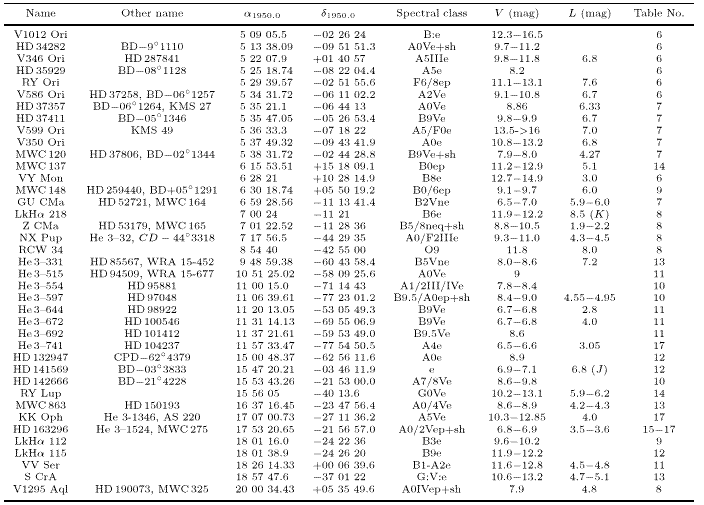
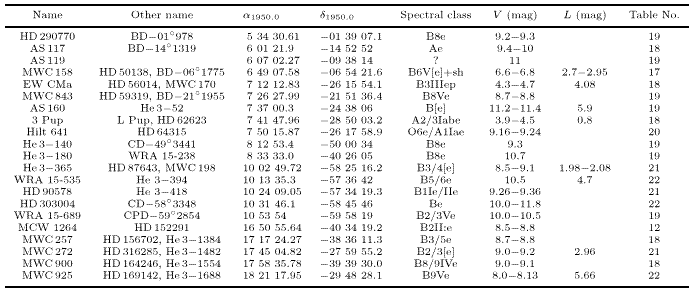
to the total number of HAEBE stars and candidate members The et al.
(1994), the number of HAEBE stars which have now be
investigated polarimetrically is small (
photometry of photometrically active
HAEBE stars with Algol-like minima
(Grinin et al. 1988; Voshinnikov & Grinin
1988; Berdyugin et al. 1990, 1992
etc.). In the 1990s polarimetric studies of
HAEBE stars were reported by Jain et al. (1990),
Hutchinson et al. (1994) and more intensively by
Jain et al. (1995), but these observations also included
only limited lists of HAEBE stars (8, 11 and 24 respectively). In relation
to the total number of HAEBE stars and candidate members The et al.
(1994), the number of HAEBE stars which have now be
investigated polarimetrically is small ( ; Yudin
1988, 1992).
Moreover, with few exceptions, no circular polarization measurements have
been carried out for a sample of HAEBE stars to date. This deficit of
polarimetric data does not allow us to judge the polarimetric
characteristics of HAEBE stars as a definite group of young objects.
; Yudin
1988, 1992).
Moreover, with few exceptions, no circular polarization measurements have
been carried out for a sample of HAEBE stars to date. This deficit of
polarimetric data does not allow us to judge the polarimetric
characteristics of HAEBE stars as a definite group of young objects.
Polarimetric variability is detected in most investigated HAEBE stars (Vrba 1975; Garrison & Anderson 1978; Vrba et al. 1979). Some of the objects show variability on a long time-scale: years, months (Scarrott et al. 1989; Jain et al. 1990, 1995). Scarrott et al. (1989) found changes in position angle (PA) for R Mon on a time-scale of years and assumed that they were caused by the precession of the circumstellar (CS) disc around the object. Other HAEBE stars with Algol-like minima show variability on a time-scale of days and an increase in the degree of polarization is accompanied by a decrease in visual flux (Grinin 1994). Such variations are explained in terms of nonperiodic eclipse of stellar light by rotating "protoplanetary" condensations. Note that, in all the above cases, the main origin of polarization is scattering by dust grains in CS shells. However, it is well known that HAEBE stars are also surrounded by extended and dense gas shells, which may also contribute to the observed polarization. The short time-scale polarimetric variability which has been established for a few HAEBE stars (Dzhakusheva et al. 1988; Beskrovnaya et al. 1995) can be explained by Thomson scattering. Unfortunately up to now we have had no information on polarimetric variability on time-scales of hours or less, except for the few cases mentioned above. Thus, the investigation of polarimetric variability on different time-scales might give us additional information on the mechanisms of polarization.
Bastien (1985, 1988) showed that
there exists a correlation between the
polarization and infrared (IR) colour indices for young T Tau stars
(TTS). More detailed investigations of such correlations were carried out by
Yudin (1988) for a sample of TTS and HAEBE stars. He
showed that a strong linear correlation exists between  and IR
excess for all types of young stars of different spectral classes. One of
the conclusions from Yudin's (1988) work was that the
above mentioned correlations can be used for selecting stars at the pre-main
sequence (PMS) stage of evolution. However, deviation of an object's
position from the above correlations for young stars can be caused not only
by the different evolutionary status of objects but also by different
orientations of disc-like dust structures around the stars.
and IR
excess for all types of young stars of different spectral classes. One of
the conclusions from Yudin's (1988) work was that the
above mentioned correlations can be used for selecting stars at the pre-main
sequence (PMS) stage of evolution. However, deviation of an object's
position from the above correlations for young stars can be caused not only
by the different evolutionary status of objects but also by different
orientations of disc-like dust structures around the stars.
A further important factor is the relation of HAEBE stars with other groups of peculiar early type stars, such as Be and B[e] stars, luminous blue variables (LBVs) etc. The evolutionary status of a significant group of B[e] and Be stars is controversial; are they PMS stars, or at a later stage of evolution (see e.g. the investigation of the B[e] star MWC349 (Yudin 1995))? In many cases polarimetric properties of HAEBE stars and B[e] (Be) stars are similar.
Copyright The European Southern Observatory (ESO)