

The stars have been selected to include both stars from the old
metal-rich disk population, as well as more recently formed Extreme
Population I dwarf stars. The sample of stars was confined
photometrically by  and with
  and
and
 such that with the calibrations of
Edvardsson et al. (1993a) and Olsen (1984), solar-type dwarfs and subgiants are
singled out with 4500 K
such that with the calibrations of
Edvardsson et al. (1993a) and Olsen (1984), solar-type dwarfs and subgiants are
singled out with 4500 K  K,
K, 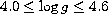 and [Me/H] > 0.10 dex. Magnitude and
metallicity data were taken from the catalogues by Olsen (1983, 1993,
1994 and priv. comm.). These
were combined with accurate velocity data (UVW) calculated by Olsen
from available proper motions and unpublished CORAVEL radial
velocities by Andersen, Mayor & Nordström, in the selection of
programme stars.
and [Me/H] > 0.10 dex. Magnitude and
metallicity data were taken from the catalogues by Olsen (1983, 1993,
1994 and priv. comm.). These
were combined with accurate velocity data (UVW) calculated by Olsen
from available proper motions and unpublished CORAVEL radial
velocities by Andersen, Mayor & Nordström, in the selection of
programme stars.
From the catalogue we seleted 42 G and K dwarf stars with [Me/H] >
0.10 for our study. 13 of these stars have  km s-1 and/or
  60 km s-1, where
  is the stellar
space velocity component in the direction of the rotation of the
Galaxy relative to the local standard of rest (LSR) and
is the stellar
space velocity component in the direction of the rotation of the
Galaxy relative to the local standard of rest (LSR) and  is the total space velocity relative to LSR. These stars were selected
to represent the chemical evolution galactic regions different from
those represented by the solar orbit, in particular located more
closely to the galactic centre. As shown in
Edvardsson et al. (1993b), Fig. 1, km s-1 singles out stars with
mean perigalactica less than 7 kpc. The 17 stars with
is the total space velocity relative to LSR. These stars were selected
to represent the chemical evolution galactic regions different from
those represented by the solar orbit, in particular located more
closely to the galactic centre. As shown in
Edvardsson et al. (1993b), Fig. 1, km s-1 singles out stars with
mean perigalactica less than 7 kpc. The 17 stars with  km s-1 represent the chemical evolution in the gas close to the
solar orbit.
km s-1 represent the chemical evolution in the gas close to the
solar orbit.
Since we also wished to explore the oxygen abundances in metal-rich disk dwarf stars on highly eccentric orbits we added 3 additional stars from the sample of stars for which Barbuy & Grenon (1990) found abnormally high [O/Fe] ratios (HD 37986, HD 77338, HD 87007). Moreover, we included 2 stars from Schuster & Nissen (1988) (HD 175518 and HD 182572).
The total final sample contains 47 stars and has 3 in common with
Edvardsson et al. (1993a): HD 30562,
HD 67228 and HD 144585.