

We showed that it is possible to make use of the information stored in the CdC plates in spite of the large variety of problems that they exhibit (triple exposures, optical aberrations, grid lines, emulsion saturation).
A general procedure in their analysis has been developed, based in the fitting to these triple exposures of a model consisting on the sum of three bi-variate Gaussian distributions in arbitrary position.
A detailed analysis of some problems in the plates was carried out. It was found that optical aberrations which result in symmetrically elongated images (spherical aberration and field curvature) dominate others which could be also present and would introduce asymmetries in the images (coma). We have seen that these particular aberrations have no influence in the final astrometric accuracy as the bivariate Gaussians are able to correctly model these elliptical images present mainly in the plate corners.
The internal plate accuracies obtained per exposure
are 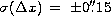 and
and
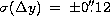 . Improvement is obtained when
considering only a
circular area around the plate centre as in this case accuracies were
. Improvement is obtained when
considering only a
circular area around the plate centre as in this case accuracies were
 for both the 22 and
12 parameter models. This demonstrates the poorer quality of images at the
plate borders due to optical distortions mainly.
for both the 22 and
12 parameter models. This demonstrates the poorer quality of images at the
plate borders due to optical distortions mainly.
The reduction with an external catalogue (PPM) gives values of
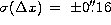 and
and
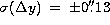 . This reduction was
done with problematic data as all the stars considered were among the
brightest ones on the plate and they exhibited larger errors in the fitting
due to the blending of the three exposures. Only 10 stars could be used as
reference stars. The differences among these
. This reduction was
done with problematic data as all the stars considered were among the
brightest ones on the plate and they exhibited larger errors in the fitting
due to the blending of the three exposures. Only 10 stars could be used as
reference stars. The differences among these  and
and
 are most probably due to the poorer quality of the bright
images and/or problems in the telescope tracking.
are most probably due to the poorer quality of the bright
images and/or problems in the telescope tracking.
The 12 free parameter model is found to be equivalent to the 22 parameter model for the internal reduction but for the external reduction results are better with the first one. This is because although the 22 parameter model is capable of reproducing the data in a more detailed way it is also more sensitive to individual image errors.
A photometric reduction was also performed using a homogeneous sample of
data from Eggen & Sandage (1964) mainly, with a resulting
accuracy of  . Photometry with the 12
parameter model gives the same result, so the photometry is not affected by
the change in the model in these two particular cases.
. Photometry with the 12
parameter model gives the same result, so the photometry is not affected by
the change in the model in these two particular cases.
Improvements to the algorithm have been also outlined on the basis of the
results obtained with a Principal Component Analysis of the data which
indicates that a model with at least 7 free parameters instead of 22 is
possible. These parameters are: one peak density (A), one profile width
 , one saturation parameter (s), one orientation parameter (t),
one background (B) and the triangle centre coordinates (
, one saturation parameter (s), one orientation parameter (t),
one background (B) and the triangle centre coordinates ( ,
,
 ).
).
Acknowledgements
The authors wish to thank Drs. H.-J. Tucholke and M. Geffert for providing us with part of the software used in this work, together with Dr. M. Odenkirchen, Dr. A. Fernández-Soto and Prof. Dr. K.S. de Boer for very useful discussions and comments. Dr. Th. Lentes provided us with his software to perform the Principal Components Analysis. We are very grateful to Bordeaux Observatory for providing us several CdC plates from their archives. We also thank SIMBAD Data Base at the CDS (Strasbourg, France) for providing us part of the data used.
This work has been carried out in the frame of a European Community (EC) Network entitled "Salvaging an astrometric treasure'' (project no. CHRX-CT94-0533) within the "Human and Capital Mobility'' program. The authors duly acknowledge the support of the EC, specially A. Ortiz-Gil and M. Hiesgen with regards to their fellowships.