

The "Carte du Ciel'' (CdC in what follows)
was one of the first large international joint astronomical projects of the
history.
It was officially initiated in 1887 with a double target: the construction
of a sky catalogue complete down to the  magnitude (which eventually became the Astrographic Catalogue) and the
construction of a sky chart down to the
magnitude (which eventually became the Astrographic Catalogue) and the
construction of a sky chart down to the  magnitude.
These projects represent the very first photographic registers of the
whole sky. In consequence, they constitute a very important source of data
for proper motion studies (see, for example, Geffert et al.
1996) because of the large time interval when comparing with today
observations (about one hundred years in most of the cases) as well as for
studies on galactic structure and kinematics.
magnitude.
These projects represent the very first photographic registers of the
whole sky. In consequence, they constitute a very important source of data
for proper motion studies (see, for example, Geffert et al.
1996) because of the large time interval when comparing with today
observations (about one hundred years in most of the cases) as well as for
studies on galactic structure and kinematics.
Part of the data was completely measured and the results were published as "Astrographic Catalogue''. A re-reduction with these published data has been recently performed by Urban & Corbin (1996). Other groups are taking a complete CdC second epoch plates (Potter et al. 1996). On the other hand, Carte plates have never been systematically measured because they were not intended to give positions but only to be a sky chart. But due to the deeper images taken (we have identified stars fainter than B=15 (Hiesgen et al. in preparation) these plates are of great importance because of the large amount of data they contain and the time elapsed since they were produced.
The plates were exposed three times, with the exposures being placed
at the vertices of an approximately equilateral triangle (see Fig. 1 (click here)).
They were also provided with a grid of perpendicular lines in order to ease
the star position measurements. These two characteristics make the accurate
measurement of positions very difficult in some specific cases because of:
1) merging of the three images when the star is brighter than
 and then the presence of an adjacency photographic
effect called "Kostinsky effect'' (Kostinsky 1907; Ross
1921) which increases the measured distance
between the exposures, and 2) stars lying on a grid line or close enough
to let the Kostinsky effect show up. Optical aberrations (mainly
spherical aberration and field curvature) are also present.
and then the presence of an adjacency photographic
effect called "Kostinsky effect'' (Kostinsky 1907; Ross
1921) which increases the measured distance
between the exposures, and 2) stars lying on a grid line or close enough
to let the Kostinsky effect show up. Optical aberrations (mainly
spherical aberration and field curvature) are also present.
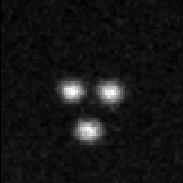
Figure 1: One star as example for the triple exposures on the CdC plates
These problems have prevented astrometrists till now from using these triple image plates as a valuable source of data, although there are some punctual exceptions (see Geffert et al. 1996, for a recent example). In this paper our aim is to show that good astrometric and photometric results are achievable, following the general procedure outlined in this work. A different procedure was proposed by Bonnefond (1991) and used by Geffert et al. (1996). Our method is able to deal with stars brighter than the upper limit of V=9.5 in Geffert et al. (1996) because it can work with blended images.
A European Community Human and Capital Mobility
Network was initiated in 1994 under the name of "Salvaging an Astrometric
Treasure'' (Ortiz-Gil et al. 1995; Hiesgen et al.
1996) with the scope of measuring
these plates and using the data for a variety of applications, such as
extension of the Hipparcos reference system to fainter magnitudes,
determination of proper motions with an accuracy of  arcsec/yr, proper motions
of globular and open clusters, photographic magnitudes with an accuracy of
about 0.1 , or studies related to galactic structure and kinematics.
arcsec/yr, proper motions
of globular and open clusters, photographic magnitudes with an accuracy of
about 0.1 , or studies related to galactic structure and kinematics.
Different typical CdC plates have been analysed in order to study how to
deal with the
specific problems which arise and may vary much from plate to plate. Therefore,
a complete study of the characteristics of each individual plate is necessary.
Here we present the complete analysis
performed with a
plate which was gently provided by Bordeaux Observatory (France). It was
taken in February 1922 and covers a  field with
centre at
field with
centre at  and
and
 (1900 equinox). This field is
interesting because it includes the open cluster M67. It shows three
exposures (Fig. 1 (click here)), placed at the vertices of a triangle.
(1900 equinox). This field is
interesting because it includes the open cluster M67. It shows three
exposures (Fig. 1 (click here)), placed at the vertices of a triangle.
The plate was scanned with the PDS 2020 GM microdensitometer
of the Astronomical Institute Münster (Germany). In the process of scanning
the plate on-line search and segmentation techniques were employed, which
produced an output file containing detected objects in the form of
"picture frames'' of individual images (Horstmann 1988).
These frames have a size of
microdensitometer
of the Astronomical Institute Münster (Germany). In the process of scanning
the plate on-line search and segmentation techniques were employed, which
produced an output file containing detected objects in the form of
"picture frames'' of individual images (Horstmann 1988).
These frames have a size of  pixels (
 mm), or
 pixels (
 mm) in the case of bright stars, to
assure that all three exposures belonging to the same triangle are included
in the frame.
mm) in the case of bright stars, to
assure that all three exposures belonging to the same triangle are included
in the frame.
Visual inspection of these frames allows us to remove from the set those frames in which any of the three exposures is missing, there is confusion between exposures due to the presence of double stars or the system has identified a spurious image. This implies that we can end up with at most three different frames corresponding to the same triplet. They are identified by their equal positions on the plate and the one which will be finally used in the study of the plate characteristics and reduction will be the one giving a better fit to the triple Gaussian model described later.
In the rest of this work we have assigned the following numbers to the three exposures: exposure 1 (top left exposure in Fig. 1 (click here)), exposure 2 (top right exposure in Fig. 1 (click here)) and exposure 3 (bottom exposure in Fig. 1 (click here)).