

The observations were taken with the Australia Telescope Compact Array
in 1994 January and September in 6A-configuration. The resolution
is 6 in right ascension and
  10 in declination.
The full width at half maximum (FWHM)
of the primary beam (PB) of the antennae at the frequency of the
observations is
10 in declination.
The full width at half maximum (FWHM)
of the primary beam (PB) of the antennae at the frequency of the
observations is  .
The area of the Disk region was covered with 910 pointing centres,
separated by 30
.
The area of the Disk region was covered with 910 pointing centres,
separated by 30 . The coverage is complete for offset
  which translates to a primary-beam response (PBR) of 0.25.
For observational convenience, the observations
were taken in two "g blocks''; one for
which translates to a primary-beam response (PBR) of 0.25.
For observational convenience, the observations
were taken in two "g blocks''; one for  (part B) and one for
  (part A) as can be
seen in Fig. 1.
In part A the pointing centres are not distributed in the honeycomb
pattern described in Paper I, but rather in a rectangular pattern,
for reasons of temporary observational incompetence.
The data were taken in two linear polarizations, using a total
bandwidth of 4 MHz and
1024 spectral channels (channel separation 3.9 kHz, correlator
frequency resolution 4.69 kHz).
The spectral band was centred at 1612 MHz, offset by 0.231 MHz
from the rest frequency of the OH transition. No Doppler tracking
was used during the observations. The velocity coverage is
(
(part A) as can be
seen in Fig. 1.
In part A the pointing centres are not distributed in the honeycomb
pattern described in Paper I, but rather in a rectangular pattern,
for reasons of temporary observational incompetence.
The data were taken in two linear polarizations, using a total
bandwidth of 4 MHz and
1024 spectral channels (channel separation 3.9 kHz, correlator
frequency resolution 4.69 kHz).
The spectral band was centred at 1612 MHz, offset by 0.231 MHz
from the rest frequency of the OH transition. No Doppler tracking
was used during the observations. The velocity coverage is
( ) for all fields except those with
  in part A, for which the coverage is
(
in part A, for which the coverage is
(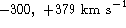 ) because they were partly observed in September.
The data were Hanning smoothed to give a velocity resolution of
) because they were partly observed in September.
The data were Hanning smoothed to give a velocity resolution of
 (7.8 kHz).
The observations were taken using a "gmosaic" mode, to optimize
uv-sampling (for details see Paper I).
The secondary calibrators
observed in the Disk region were 1740-517 (part B)
and 1414-590 (part A). The primary calibrators are
the same as in the Bulge region, 1934-638 and/or 0823-500.
The average integration time per pointing is 9 min, resulting in an
average noise level in empty cubes of 29.6 mJy.
(7.8 kHz).
The observations were taken using a "gmosaic" mode, to optimize
uv-sampling (for details see Paper I).
The secondary calibrators
observed in the Disk region were 1740-517 (part B)
and 1414-590 (part A). The primary calibrators are
the same as in the Bulge region, 1934-638 and/or 0823-500.
The average integration time per pointing is 9 min, resulting in an
average noise level in empty cubes of 29.6 mJy.