

Fabry-Perot interferometers (FPI) are most attractive for
the development of filter magnetographs because of their
compact configuration (Rust 1985, 1986). In the case of a
solid-state Fabry-Perot etalon the eguation

holds, where
 - wavelength corresponding to the middle of the passband;
n - refractive index of the etalon material;
N - the order of interference;
d - thickness of the etalon; and
- wavelength corresponding to the middle of the passband;
n - refractive index of the etalon material;
N - the order of interference;
d - thickness of the etalon; and
 -angle between the incoming beams and a normal to the etalon
surface.
-angle between the incoming beams and a normal to the etalon
surface.
As follows from the expressions (1), the position
of the passband of the etalon depends on several factors. Of
them, the angle  and the refractive index n are most suitable
for control. How can an etalon-based bichromatic image filter
be created? A first opportunity presents itself when the
incoming light beam is divided into two by means of a prism made
of birefringent material and constructed in such a manner that
the beam of one polarization leaves the prism at a small angle
to the beam of a different polarization. Note that the angular
path of the beams that have passed through the filter, is
readily reconstructed by means of an identical, suitably oriented
polarization prism, and there arise no problems with ghosting.
For a relative displacement of the bands of the order of 100 mÅ
it is sufficient that this angle is about
and the refractive index n are most suitable
for control. How can an etalon-based bichromatic image filter
be created? A first opportunity presents itself when the
incoming light beam is divided into two by means of a prism made
of birefringent material and constructed in such a manner that
the beam of one polarization leaves the prism at a small angle
to the beam of a different polarization. Note that the angular
path of the beams that have passed through the filter, is
readily reconstructed by means of an identical, suitably oriented
polarization prism, and there arise no problems with ghosting.
For a relative displacement of the bands of the order of 100 mÅ
it is sufficient that this angle is about  . In this case, by
tilting the etalon, it is possible to vary the relative
displacement of the passbands
. In this case, by
tilting the etalon, it is possible to vary the relative
displacement of the passbands  over a reasonably wide
range. One may achieve, for example, that both beams are let
pass in the same spectral band (
over a reasonably wide
range. One may achieve, for example, that both beams are let
pass in the same spectral band ( = 0 if
  ),
or it is possible to reverse the position of the passbands. Tilting the
etalon is also used for exact tuning to the desired wavelength
by producing a quasi-constant displacement. Therefore, to ease
the assessments of the modulation of the already tilted etalon,
we transform the expression (1). Differentiating (1) with respect
to
),
or it is possible to reverse the position of the passbands. Tilting the
etalon is also used for exact tuning to the desired wavelength
by producing a quasi-constant displacement. Therefore, to ease
the assessments of the modulation of the already tilted etalon,
we transform the expression (1). Differentiating (1) with respect
to  and substituting
 we get

For the case with two beams,  ,
and
,
and  is the angle between the beams,
and
is the angle between the beams,
and  is the angle between a normal to the etalon and
the bisector of the angle formed by two beams. The expression
(2) becomes suitable for a direct calculation of
is the angle between a normal to the etalon and
the bisector of the angle formed by two beams. The expression
(2) becomes suitable for a direct calculation of  .
.
Another way of developing a two-bandpass filter based on a
Fabry-Perot etalon is to use a birefringent material as the gap
within the Fabry-Perot etalon. Traditionally, birefringence of
the material in the Fabry-Perot presents an objectionable
property in so far as it gives rise to the appearance of
additional transmission bands.
By way of example, such is the case for the manufacture of
a Fabry-Perot etalon with the gap made of artificial
fluorophlogopite. The difference of refractive indices
 = 4.29
  10
10 , or is lower than in natural mica.
This can be gor rid of by choosing the plate thickness such
that the path difference be
, or is lower than in natural mica.
This can be gor rid of by choosing the plate thickness such
that the path difference be  . This is not always possible,
hence it is customary to use a Fabry-Perot etalon in the
plane-polarized light beam.
For our purposes, however, this property proves to be
useful.
. This is not always possible,
hence it is customary to use a Fabry-Perot etalon in the
plane-polarized light beam.
For our purposes, however, this property proves to be
useful.
Intresting possibility of creating two-band filters arises
when we use the control over the refractive index of some
crystals suitable for manufacturing FPI. The possible uses of
lithium niobate plates as a tunable Fabry-Perot etalon were
considered by Rust & Bonaccini (Rust 1986; Bonaccini
1988). For tunable FPI, lithium niobate plates of both Z-cut and
Y-cut are used. The latter, even without any voltage applied,
transmit the light in two spectrally separated and orthogonally polarized
beams (Bonaccini 1988) i.e.,
they satisfy the two above-formulated main requirements imposed
upon bichromatic image filters. The refractive index of an
extraordinary ray  depends little on the voltage applied to the
etalon, while the refractive index of an ordinary ray
depends little on the voltage applied to the
etalon, while the refractive index of an ordinary ray  is
related to the voltage by a linear relationship. Hence it
becomes possible to vary (with a fixed position of one spectral
band) the position of another as required. However, using
directly such a crystal for our problem is complicated by the
fact that, with no voltage applied,
is
related to the voltage by a linear relationship. Hence it
becomes possible to vary (with a fixed position of one spectral
band) the position of another as required. However, using
directly such a crystal for our problem is complicated by the
fact that, with no voltage applied,  exceeds significantly
the requisite values. To compensate for this displacement, a
sufficiently high voltage should be applied there to, which in
turn will cause a marked piezoelectric effect, and this must be
taken into account. The functional scheme of FPI's filter
magnetograph in the bichromatic mode is shown in Fig. 2.
exceeds significantly
the requisite values. To compensate for this displacement, a
sufficiently high voltage should be applied there to, which in
turn will cause a marked piezoelectric effect, and this must be
taken into account. The functional scheme of FPI's filter
magnetograph in the bichromatic mode is shown in Fig. 2.
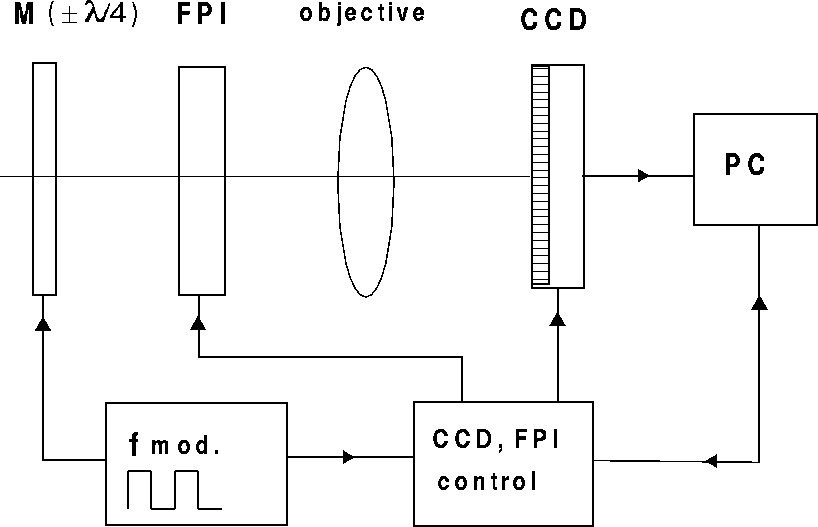
Figure 2: A simplified block-scheme of FPI-based filter magnetograph
in the bichromatic mode
Next we consider the possibilities afforded by magnetooptical filters (MOF). It is well known (Agnelli et al. 1975; Cacciani & Fofi 1978; Cacciani 1981; Rhodes et al. 1984; Cacciani et al. 1991) that, when placed in a longitudinal magnetic field, cells with vapours of some metals have the remarkable properties:
- the cell absorbs the right-handedly circularly polarized
light at the wavelength  and the left-handedly polarized
light at
and the left-handedly polarized
light at  , i.e., it behaves as if there were two narrow-band
circular polarizers;
, i.e., it behaves as if there were two narrow-band
circular polarizers;
- depends not only on H, but also on the density
of vapours in the cell specified by the evaporator's current (Rhodes
et al. 1984).
depends not only on H, but also on the density
of vapours in the cell specified by the evaporator's current (Rhodes
et al. 1984).
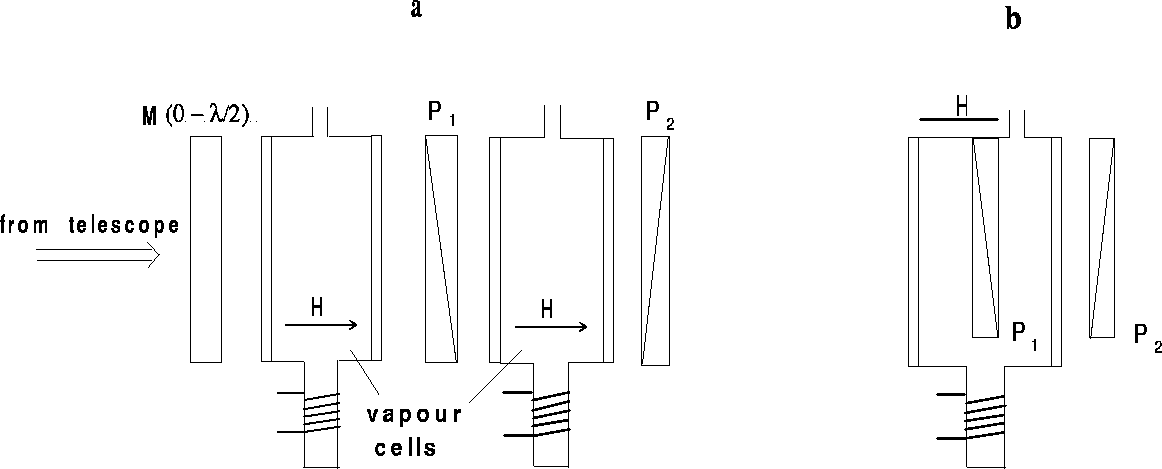
Figure 3: Examples of functional schems of a MOF-based
magnetographs in the bichromatic image mode:
a) with two optical resonance cells
b) optimum version with a single cell
To obtain a bichromatic image, it is sufficient to place the
cell between two crossed polarizers. The cell output in this
case will receive the linearly polarized light in two spectral
bands corresponding to  and
and  . If exactly
the same cell is placed ahead, but without polarizers and with
the modulator
. If exactly
the same cell is placed ahead, but without polarizers and with
the modulator  at the input, then we get an instrument for measuring the
longitudinal magnetic field strength, Fig. 3a. In fact, if to
the zero phase of the modulator there will correspond a value of
intensity
at the input, then we get an instrument for measuring the
longitudinal magnetic field strength, Fig. 3a. In fact, if to
the zero phase of the modulator there will correspond a value of
intensity 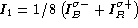 ,
then with the phase
,
then with the phase  the circular
polarization of the Zeeman components changes sign, and the
intensity takes on the value of
the circular
polarization of the Zeeman components changes sign, and the
intensity takes on the value of 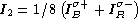 . As has been
pointed out previously, these two frames will suffice for
obtaining an
. As has been
pointed out previously, these two frames will suffice for
obtaining an  -magnetogram, with the elimination of the
dependence on the line-of-sight velocity and brightness.
-magnetogram, with the elimination of the
dependence on the line-of-sight velocity and brightness.
Note that if the first cell is placed in a variable
magnetic field  , then there is no need for a
polarization modulator at the cell input. And if it is taken into
consideration that for the second cell the field reversal is
unimportant, then both cells can be placed in a common
alternating field. In this case a simplified hypothetical design
of a filter magnetograph
, then there is no need for a
polarization modulator at the cell input. And if it is taken into
consideration that for the second cell the field reversal is
unimportant, then both cells can be placed in a common
alternating field. In this case a simplified hypothetical design
of a filter magnetograph  would appear as one in Fig. 3b
wher both cells are combined into one, whose communicating space
is separated by the polarizer into two equal parts. Obviously, in
this case the shape and position of the bands will coincide
best, and this will favorably influence the accuracy of the
magnetograph. Such a coincidence is difficult to expect for the
design in Fig. 3a. The magnetic field of the combined cell may
also be constant; in this case the filter input has to incorporate
a circular polarization modulator such as in the design of Fig. 3a.
Some technical difficulties associated with the placing of the
polarizer inside the cell, do not seem to be insurmountable.
Instead, the identity of temperature, pressure and magnetic
field inside each of the parts of the cell will ensure an ideal
matching of their spectral characteristics.
would appear as one in Fig. 3b
wher both cells are combined into one, whose communicating space
is separated by the polarizer into two equal parts. Obviously, in
this case the shape and position of the bands will coincide
best, and this will favorably influence the accuracy of the
magnetograph. Such a coincidence is difficult to expect for the
design in Fig. 3a. The magnetic field of the combined cell may
also be constant; in this case the filter input has to incorporate
a circular polarization modulator such as in the design of Fig. 3a.
Some technical difficulties associated with the placing of the
polarizer inside the cell, do not seem to be insurmountable.
Instead, the identity of temperature, pressure and magnetic
field inside each of the parts of the cell will ensure an ideal
matching of their spectral characteristics.
The posibility of working with reasonably large angular apertures of incoming beams is an important merit of MOF. There are no problems whatsoever when working with the image of the full solar disk or when using short-focus optical systems. Obviously, however, limited possibilities of choosing optical wavelengths should be recognized as the most serious disadvantage of MOF.