

In this paper we present CCD VI photometry for the galactic cluster
Berkeley 66. Berkeley 66 was discovered by Setteducati & Weaver (1962)
in their search for unknown stellar clusters in the galactic disk. They suggested
that the cluster has an angular diameter of about  and it is
very faint, the typical magnitude for the brightest stars being
and it is
very faint, the typical magnitude for the brightest stars being  .
.
The equatorial and galactic coordinates for the 1950.0 equinox are
 ,
,  and
and  ,
,
 , respectively. In the Berkeley catalogue it is included in the
sample of possible clusters, and since then no other studies have been
performed to our knowledge.
, respectively. In the Berkeley catalogue it is included in the
sample of possible clusters, and since then no other studies have been
performed to our knowledge.
This analysis is a part of a project aiming at collecting good photometric data
for unstudied or poorly studied intermediate age and old open clusters. In the
case of Berkeley 66 the selection of the target object has been done following
the suggestion of Phelps et al. (1994), who listed in their Table 4 a
sample of potentially old still unstudied clusters. Berkeley 66 is also designated as
C 0304+583 and OCL 373, and classified of  Trumpler type.
Berkeley 66 has been recently studied by Phelps & Janes (1996). A comparison with this work is given in the conclusions of the paper.
In Sect. 2 we present observations and data reduction; in Sect. 3 we describe the CMD of Berkeley 66 and derive its fundamental parameters. Finally Sect. 4 give some concluding remarks.
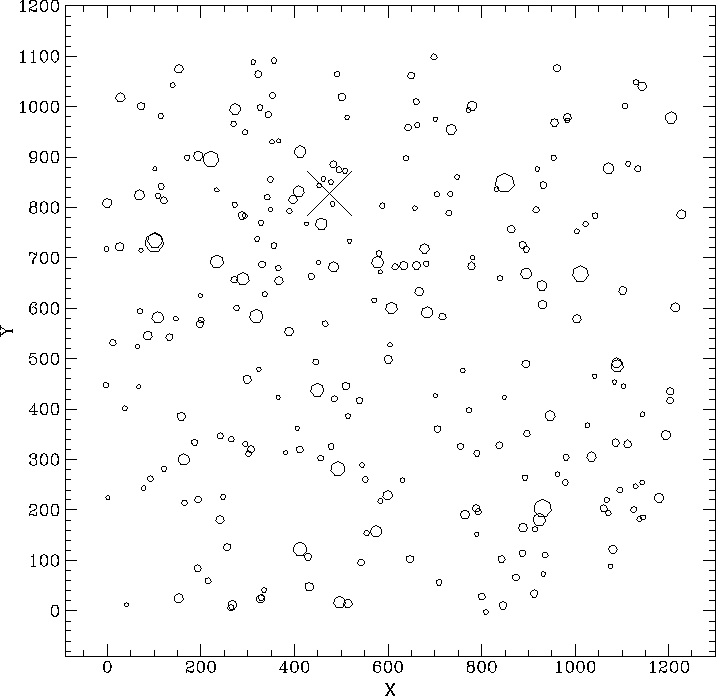
Figure 1: Finding chart for the stars detected in the field of Berkeley 66.
The dimensions of open circles is a function of the V magnitude